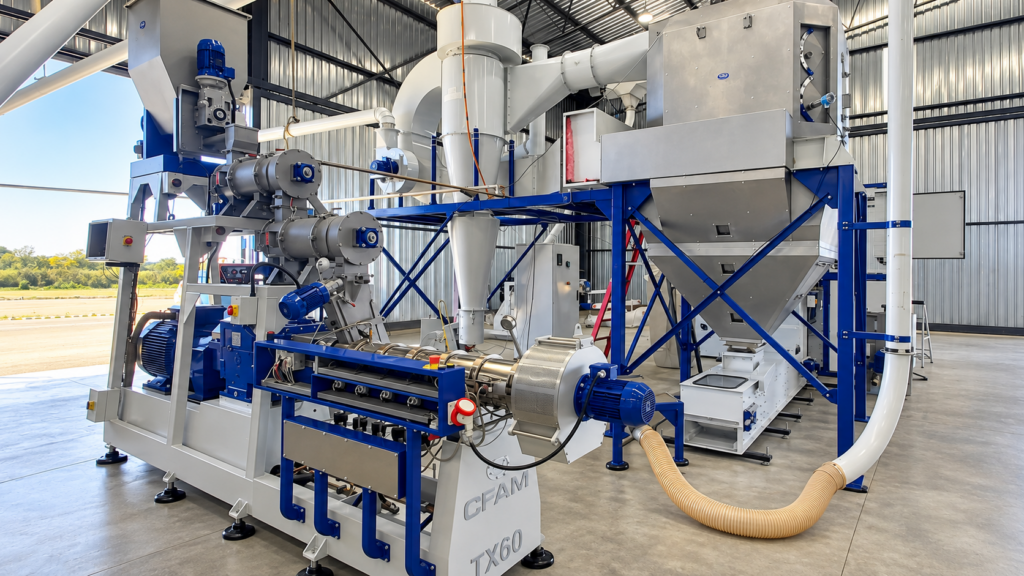
Inside an extruder, screw design plays an important role in how raw materials are conveyed, mixed and cooked. It influences the mechanical energy applied to the ingredients and, ultimately, the characteristics of the finished product. For food and feed manufacturers, this makes the choice between single-screw and twin-screw extrusion an important production decision.
Single-screw extruders can perform well in established applications with consistent formulations. Twin-screw extrusion offers particular advantages when manufacturers need stronger mixing, greater control and the flexibility to process different raw materials. These benefits are especially relevant when developing products with more demanding ingredient combinations.
More effective conveying and mixing
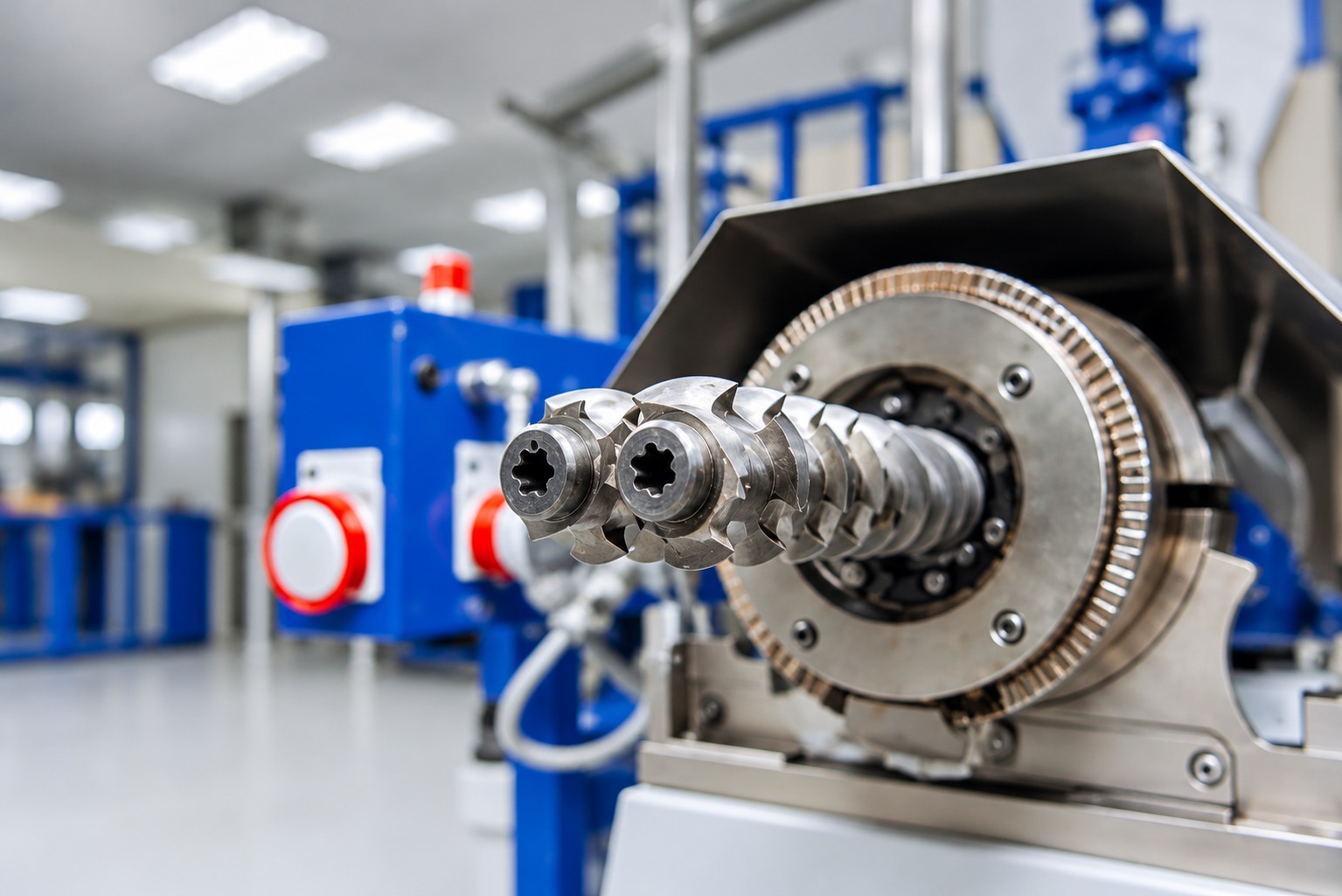
A single-screw extruder uses one rotating screw to move material through the barrel. In an intermeshing twin-screw system, two screws work together to convey and mix the ingredients. This arrangement provides effective material handling and intensive mixing, including for formulations that are sticky, oily or high in moisture.
For manufacturers, effective mixing helps distribute ingredients and moisture more evenly throughout the product. This is particularly useful when working with blends of grains, plant proteins and other ingredients that behave differently during processing. A more uniform mixture supports consistent cooking and helps reduce unwanted variation in the finished product.
Greater control over mechanical energy
Extrusion combines heat, moisture and mechanical energy to transform raw materials. The screws do more than move ingredients forward: their configuration determines where conveying, mixing and shearing take place.
In a modular twin-screw extruder, different screw elements can be arranged to suit the processing task. This gives manufacturers more scope to tailor the treatment of the material, whether the aim is to develop an expanded snack, cook a cereal blend or texturise a plant protein. The objective is to apply the appropriate level of energy for the product.
Process control is another advantage. In co-rotating twin-screw systems, feed rate and screw speed can be adjusted with greater independence, giving operators additional ways to manage processing conditions. These settings still interact with moisture, temperature and formulation, so successful production depends on balancing the complete process.
More flexibility for ingredients and product development
Changing a formulation can change how it behaves inside an extruder. Introducing wholegrain flour, increasing protein content or adjusting fat and fibre levels may affect material flow, cooking and expansion. Twin-screw technology gives manufacturers a wider operating range for exploring these changes.
This flexibility is valuable for businesses developing new products or responding to changes in ingredient supply. Instead of relying on one fixed recipe, manufacturers can evaluate alternative blends and adjust the process to meet the intended product requirements. Trials remain essential to confirm what works on a particular machine and formulation.
A stronger foundation for consistent production
Better mixing and greater process control can support more uniform product characteristics. For snacks, this may include expansion, density and texture. In feed applications, control of processing conditions can help manufacturers achieve different pellet densities, including floating and sinking products.
The right equipment choice depends on the application, production targets and investment requirements. Single-screw extrusion remains a practical option for many products. Where ingredient flexibility, intensive mixing and product development are priorities, twin-screw extrusion offers clear advantages.
At the heart of those advantages is the screw configuration. Matching it to the raw materials and intended product helps manufacturers turn the capability of the equipment into reliable production results.