Many established animal-feed companies already operate conventional pelletising plants. These systems are widely used for poultry, livestock and certain fish feeds. However, modern aquaculture increasingly requires feed that does more than deliver nutrients. Depending on the species and farming system, pellets must float, sink at a controlled rate, remain stable in water and retain their nutritional value. This raises an important question: When is conventional pelletising sufficient, and when does the market require extrusion?
Where conventional pelletising still has a role
Conventional pelletising uses steam conditioning and mechanical compression to produce dense pellets. It remains a suitable option for certain aqua feed applications, particularly when producing basic sinking feeds for bottom-feeding species or lower-cost products for semi-intensive farming systems. Pelletising may also be commercially appropriate when production volumes are small, oil requirements are moderate or an existing pellet mill has sufficient capacity. The technology itself is not outdated. Its suitability depends on the product being manufactured. However, its limitations become more apparent when feed must have carefully controlled physical behaviour in water.
Why modern aqua feed increasingly requires extrusion
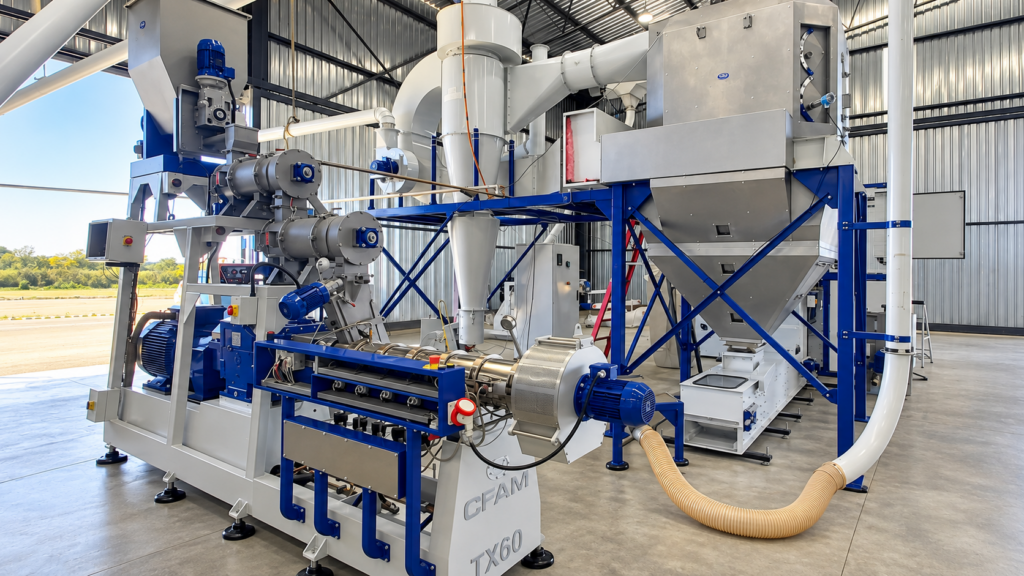
Extrusion provides greater control over cooking, expansion, pellet density and water stability. Unlike conventional pelletising, extrusion processes feed using controlled moisture, temperature, pressure and mechanical shear. As the cooked material passes through the die, controlled expansion creates the internal structure required for different pellet characteristics. This allows manufacturers to produce:
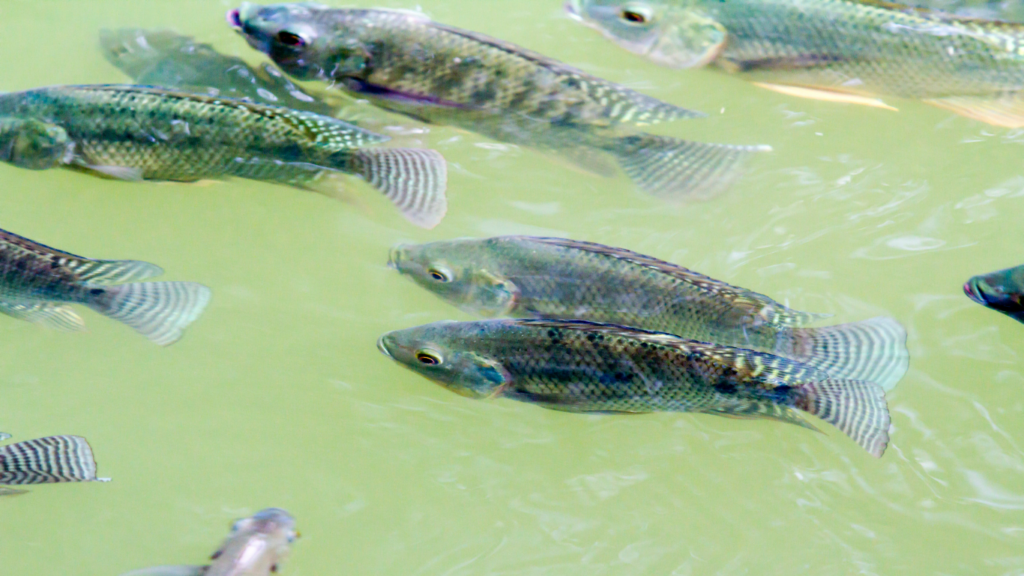
- Floating feed for species such as tilapia and African catfish
- Slow-sinking feed for species that feed throughout the water column
- Dense sinking feed for bottom-feeding species
- Small starter pellets
- High-energy feeds with increased oil absorption
Floating feed is especially valuable in commercial tilapia and catfish farming because farmers can observe feeding activity, monitor fish behaviour and reduce wastage. Extrusion also provides greater flexibility when processing different ingredients and developing specialised formulations.
The importance of preconditioning
Successful extrusion begins before the material enters the extruder. During preconditioning, steam and water are added to the mixed feed to increase temperature, hydrate ingredients and begin starch gelatinisation. Effective preconditioning can improve process stability, cooking, throughput and product consistency while reducing the energy required during extrusion. Poor preconditioning, however, can lead to inconsistent moisture, unstable processing and variable pellet density. The extruder cannot compensate fully for inadequate upstream preparation.
Single-screw versus twin-screw extrusion
Both single-screw and twin-screw extruders are used in commercial aqua feed production. Single-screw extruders generally offer lower capital costs, simpler mechanical designs and established performance in suitable high-volume applications. Twin-screw extruders provide greater flexibility through positive material conveying, improved mixing and more adaptable screw configurations. This can be particularly valuable when working with variable local raw materials or producing multiple feed types. Twin-screw technology may also offer greater control when processing difficult formulations or operating at higher moisture levels. However, it generally requires greater capital investment and more specialised maintenance. The appropriate technology should be selected according to the intended product range, ingredient characteristics, production capacity and available technical expertise.
Extrusion improves more than pellet appearance
The benefits of extrusion extend beyond floating and sinking behaviour. When properly controlled, extrusion can improve starch gelatinisation, increase nutrient accessibility and reduce certain heat-sensitive anti-nutritional factors. It can also improve pellet binding and water stability. However, excessive heat or mechanical energy may damage sensitive nutrients and produce fragile pellets. The objective is therefore not maximum cooking or expansion, but controlled processing that achieves the required nutritional and physical properties.
A complete aqua feed plant requires more than an extruder
High-quality aqua feed depends on the performance of the entire production line.
The aqua feed production process
Preconditioning
Preparing and hydrating the ingredients
Extrusion
Cooking and forming the pellets
Drying
Controlling moisture and shelf life
Coating
Adding oils and functional ingredients
Cooling and screening
Preparing consistent feed for packaging.
Drying is particularly important because excessive moisture can cause mould and reduce shelf life, while over-drying can produce fragile pellets and unnecessary energy consumption. Coating systems also play an important role. For high-energy feeds, vacuum coating allows oil to penetrate the pellet structure rather than remaining primarily on the surface. Each processing stage must be designed around the requirements of the finished product.
Converting an existing pelletising plant
An established animal-feed manufacturer does not necessarily need to replace its entire factory to enter the extruded aqua feed market. Depending on their condition and suitability, existing systems for raw-material intake, storage, grinding, dosing, mixing, steam supply, packaging and warehousing may be retained. A specialised extrusion section can then be integrated into the existing production process. A phased conversion strategy typically includes assessing the existing plant and market demand, developing products using available raw materials, installing the required processing equipment and validating the finished feed through production and farm trials. This approach allows manufacturers to build on existing infrastructure while introducing the technology needed for specialised aqua feed production.
When is extrusion commercially justified?
Extrusion normally requires greater capital investment than conventional pelletising. It may also involve higher energy consumption, more advanced automation and additional operator training. However, it can create commercial value through improved product quality, reduced feed wastage, greater formulation flexibility and access to more specialised markets. Conversion may be justified when customers require floating or slow-sinking feed, consistent pellet density, higher oil content, improved water stability or a wider product range. It may be less appropriate when the market primarily requires basic sinking feed, production volumes are too small or customers cannot justify the additional processing cost. The investment decision should therefore consider the complete business opportunity rather than equipment cost alone.
Conclusion
Conventional pelletising remains valuable for many animal-feed applications and selected aqua feeds. However, modern commercial aquaculture increasingly requires the additional flexibility and process control offered by extrusion. For established feed manufacturers, the opportunity is often to integrate modern extrusion, drying and coating technology into suitable existing infrastructure rather than replace the entire factory. The move from pelletising to extrusion should be driven by product and market requirements — not simply by the desire to adopt newer technology.
Through the CFAM African Aqua Feed Value Initiative, CFAM supports feed manufacturers with plant assessments, product development, technology selection, equipment integration and complete aqua feed production solutions.