Aqua feed is not one standard product. Different fish species feed in different ways, at different depths and at different stages of growth. A feed that works well for Nile tilapia in cages may be unsuitable for shrimp feeding at the bottom of a pond. A successful aqua feed business must therefore define its product portfolio around:
- Target species
- Fish size and life stage
- Farming system
- Feeding depth
- Nutritional requirements
- Pellet behaviour
- Farmer performance expectations
The main feed categories include floating, slow-sinking, sinking, starter, juvenile, grower, finisher, broodstock and specialised feeds.
Feed must match natural feeding behaviour
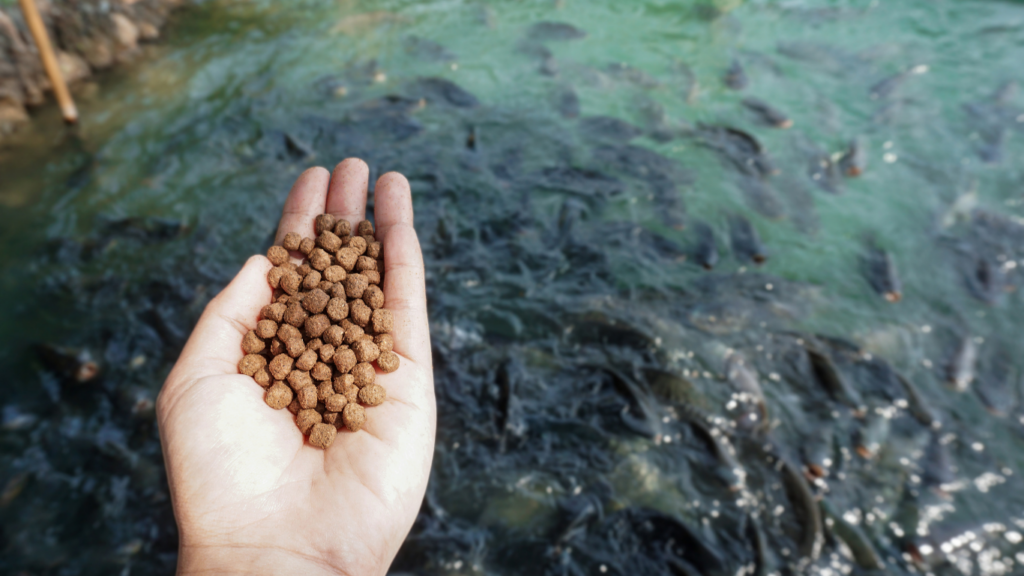
Fish do not all feed in the same part of the water column. Some species readily feed at the surface. Others intercept pellets as they sink, while bottom-feeding species require feed that reaches the pond or tank floor. The choice between floating, slow-sinking and sinking feed should therefore be based on biology and farm economics, not simply on what is easiest to manufacture.
Floating feed
Floating feed has a density lower than water and remains on or near the surface. It is commonly used for species such as:
- Nile tilapia
- African catfish
- Carp in certain systems
- Ornamental fish
One of its main advantages is visibility. Farmers can observe feeding activity, identify reduced appetite, limit overfeeding and monitor fish health. Floating feed can therefore help reduce waste and improve feeding control. However, a pellet that floats is not automatically high quality. Poor floating feed may break easily, produce excessive fines, sink too quickly or have inconsistent buoyancy. Extrusion is normally used because it provides better control over density, expansion, moisture and pellet structure.
Slow-sinking feed
Slow-sinking feed is designed to descend gradually through the water column. It can be useful for:
- Certain tilapia systems
- Trout
- Marine fish
- Juveniles
- Species feeding below the surface
Its main advantage is improved feed distribution. Rather than concentrating all feeding activity at the surface, slow-sinking pellets create opportunities for fish to feed at different depths. The challenge is density control. Small changes in formulation, moisture, extrusion conditions, drying or oil addition can cause the product to float or sink too quickly.
Sinking feed
Sinking feed is denser than water and moves toward the bottom. It is commonly used for:
- Shrimp and prawns
- Bottom-feeding species
- Certain marine fish
- Some carp and catfish applications
- Selected broodstock programmes
Sinking feed places nutrients in the correct feeding zone for these species. However, farmers cannot always see whether the feed has been consumed. Poor feeding management can therefore lead to overfeeding, nutrient leaching and declining water quality. For this reason, sinking feeds require excellent water stability and feeding control.
Feed changes as the fish grows
Aqua feed must also match the fish’s life stage.
Starter and micro-feed
Starter feeds are used during the earliest feeding stages and require:
- Very small, uniform particle sizes
- High nutrient density
- Highly digestible ingredients
- Good palatability
- Low fines
- Minimal nutrient leaching
Indicative sizes may range from approximately 0.2 mm to 1.5 mm. Although starter feeds account for relatively small volumes, they can be valuable premium products.
Juvenile feed
Juvenile feed supports rapid early growth and prepares fish for grow-out. It normally contains higher protein levels than grower or finisher diets and may range from approximately 1.5–3 mm. Good early nutrition can have a significant effect on later farm performance.
Grower feed
Grower feed often represents the largest commercial volume in an aqua feed business. Typical pellet sizes range from approximately 3–5 mm. The formulation must balance nutrient density, ingredient cost, pellet quality, feed conversion and affordability. Because grower feed represents such a large share of total feed use, small improvements in FCR can create significant financial value for farmers.
Finisher feed
Finisher feed is used during the final phase before harvest. Its objectives include maintaining efficient growth, managing feed costs and achieving the required market size and harvest uniformity. Pellet sizes may range from approximately 5–8 mm or larger, depending on the species.
Broodstock feed
Broodstock diets are designed for mature breeding fish. Rather than focusing only on body growth, they must support:
- Egg quality
- Fertility
- Spawning performance
- Larval viability
- Breeding condition
These feeds may contain specialised levels of fatty acids, vitamins, minerals and functional ingredients.
Species-specific feed programmes
Different species require different product strategies.
Tilapia
Tilapia is one of Africa’s most important farmed species. Floating feed is widely used because tilapia readily feed at the surface and farmers can monitor consumption. A commercial tilapia programme may include starter, juvenile, grower, finisher and broodstock feeds.
African catfish
African catfish is particularly important in West and Central Africa. Feeds typically require:
- Strong palatability
- High protein in early stages
- Reliable floating performance
- Good water stability
- Appropriate energy density
- Effective oil retention
Trout and marine fish
These feeds are often higher in protein and oil and may require controlled sinking behaviour, high pellet durability and vacuum coating.
Shrimp
Shrimp feed is fundamentally different from standard floating fish feed. It requires:
- Sinking behaviour
- Long water stability
- Low nutrient leaching
- Strong attractability
- High pellet durability
- Precise small-pellet production
Pellet size matters
Pellet size should match the fish’s mouth size and feeding ability. Indicative ranges include:
- Fry: 0.2–0.8 mm
- Starter: 0.8–1.5 mm
- Juvenile: 1.5–3 mm
- Grower: 3–5 mm
- Finisher: 5–8 mm
Pellet length is also important. Pellets that are too large may be rejected, while very small or broken pellets can increase fines and waste.
Define the product before designing the plant
A feed producer should define the intended product range before selecting equipment. A plant designed for large floating tilapia pellets may not be suitable for:
- 0.8 mm starter feed
- High-oil trout feed
- Slow-sinking marine feed
- Water-stable shrimp pellets
Product requirements influence decisions around:
- Grinding
- Mixing
- Preconditioning
- Extrusion
- Die size
- Drying
- Cooling
- Coating
- Screening
- Crumbling
- Packaging
This is why plant design should follow product definition — not the other way around.
Start with a focused range
New producers often try to launch too many feed types at once. This can increase:
- Product changeovers
- Formulation complexity
- Finished-product stock
- Working-capital requirements
- Contamination risk
- Quality-control demands
A stronger strategy is to begin with the products representing the largest realistic market demand and expand once the process and customer base are established.
Feed value must be measured on the farm
The real value of a feed is not simply its price per tonne. It should be measured through:
- Feed conversion ratio
- Growth rate
- Survival
- Feed wastage
- Time to market
- Water quality
- Fish-size uniformity
- Feed cost per kilogram of fish produced
A more expensive floating or starter feed may create greater value if it reduces waste, improves survival or lowers the overall cost of producing saleable fish.
Conclusion
The aqua feed market is not defined by one pellet. It is a portfolio of products developed for different species, fish sizes, feeding behaviours and farming systems. Floating feed provides visibility and feeding control. Slow-sinking feed distributes feeding through the water column. Sinking feed serves bottom-feeding species. Starter, juvenile, grower, finisher and broodstock feeds each serve a different biological and commercial purpose. The central principle is clear: The product portfolio must be defined before the plant is designed, because feed type, pellet size, density, oil content and water-stability requirements determine the processing technology needed.
Through the CFAM African Aqua Feed Value Initiative, CFAM assists clients with product definition, formulation development, extrusion trials and the design of flexible aqua feed plants suited to their target markets.